
Owls, Rodents & Galaxies
It’s six thirty on a crisp cold January evening. I pull on a second jumper and a pair of thermal socks. I’m even debating whether to pull on a pair of long-johns.
Hilary eyes me with amusement. ‘You’re never going out to that telescope tonight are you? It’s freezing out there.’
‘Of course I am. I have to do this.’
It’s true. I really need to do this. I’ve waited weeks, through rain, wind, cloud and more rain. Waited for that perfectly clear night, with no cloud or mist, and no bright moon to spoil it all. I’ve rehearsed for this. Now everything is ready.
There is a common ailment that we astrophotographers suffer from. It’s called clear sky guilt. We wait a long time for a good clear night, yet when that never ending Welsh rain finally stops and the sky is inky black and the stars are like diamonds, a kind of inertia sets in. Maybe we’re just too warm or maybe there’s something good on TV… or maybe we just can’t be bothered. Then we feel guilty because we’ve wasted a rare opportunity to do some deep sky photography. Not me, not this time.
So here I am inside my makeshift observatory. It’s not as good as my last one in Sheffield, but I did a deal with Hilary and we agreed on a compromise. Its a plastic greenhouse with a modified zippable roof, so my telescope will soon be sharing space with tomato and courgette plants. At least the Pembrokeshire skies are black, unlike the orange sky-glow of Sheffield.
To the west, the waxing crescent Moon is about to set behind Sardis mountain, closely followed by the brilliant planet Venus. Since my telescope needs to track the motion of the stars, I first align the telescope on a couple of bright ones. I choose Capella, to the north-east, a brilliant yellow star in the constellation of Auriga the charioteer. Then I swing the telescope to Vega near the zenith, a brilliant blue-white star in the constellation of Lyra. The motorised telescope mount is now calibrated and ready to start tracking the stars.
I settle in for a long night. My feathered friend, the tawny owl is already in full throat as he starts the night shift. I’ll probably hear him again in the morning as he clocks off the night shift. There’s also a faint scuffle as a hedgehog or maybe a badger sniffs around outside.
Every star that we can see in the night sky belongs to our galaxy. Each star is a sun like ours, but so far away as to be just a point of light. Galaxies are vast island universes containing billions of stars, and there are millions of galaxies out there.
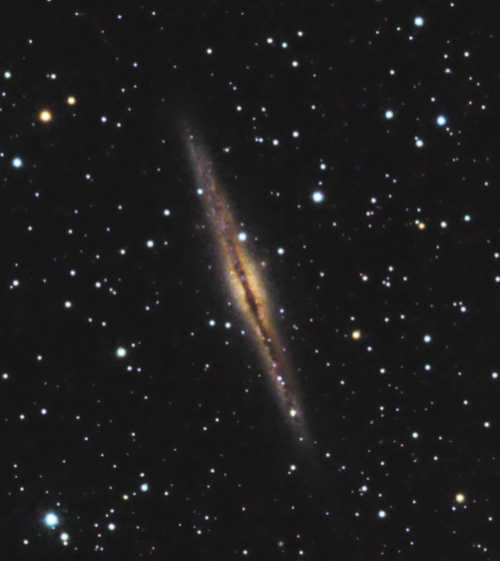
With everything ready, I swing the telescope towards my target. The one I’m chasing is a galaxy called NGC891. I’ve had a go at it before, but my quest has been thwarted for various reasons. Like our own galaxy, it is spiral shaped with a central bulge. All galaxies are beautiful, but this one is special, as we see it exactly edge-on. It’s estimated to be around thirty million light-years away.
To enhance its sensitivity, the sensor in my new camera can be cooled to 30 degrees below ambient temperature. I also need to take many long exposures, after all, the light from this galaxy will be incredibly feeble after such a long journey.
Everything is running smoothly, and the image of the galaxy is slowly building up on my laptop screen. Things are looking good and I can already see more detail in the galaxy core than I’ve ever seen before.
Things are quiet now. There is a time when all the night sounds seem to stop. There’s no wind. The sky is crystal clear and the stars so brilliant you can reach up and touch them. Even the owl is listening. I stare at the screen, checking the settings. I could retire for an hour or so with a hot mug of tea while the software does it’s stuff, but I dare not, I’m too excited, everything is going so well.
So I drift into a Zen-like state, marvelling at the fact that I am literally looking thirty million years into the past. Not only that, but somehow it’s personal. That feeble light entering my telescope and building up my image has travelled all this way, just for me. It’s my light, and nobody else’s. Light will travel 186,000 miles in one second, which seems instantaneous. Now try to imagine how far it travels in thirty million years – not easy. I often find a pint of Guinness helps.
When the light from this galaxy first started its journey to my telescope, the continents looked very different. South America had only just broken off from Antarctica and the Alps were still being formed. The Earth was starting to cool after a long period of global warming. When the light had travelled three quarters of the way, the human lineage had only just split away from the chimpanzees. With ninety percent of its journey completed, Australopithecus Afarensis was still wandering around the great rift valley of Ethiopia, and with over ninety-nine percent of the light’s journey completed, the first Neanderthals were still hunting the icy wastes of the last ice-age.
I’m woken from my Zen state by the tickle of a small furry thing around my feet. How did he get in? There’s something slightly worrying about a small creature nibbling your ankles in the pitch dark. I give him a gentle nudge and he scuttles off. Not long now. The image is nearly complete. I realise I can’t feel my toes and my finger ends are numb. With all the data safely stored on my hard drive, I start to dismantle the expensive stuff for safe storage. The telescope and camera are now dripping with condensation, and likely to freeze over pretty soon. A good time to stop.
Planet Earth is a grain of sand on a beach
stretching to an ocean of empty space
that ocean has many shorelines
beaches that live in other times
yet somewhere beyond, lie more oceans
that too have shorelines
way beyond our reach
© J M Tonks
