
The Visitor
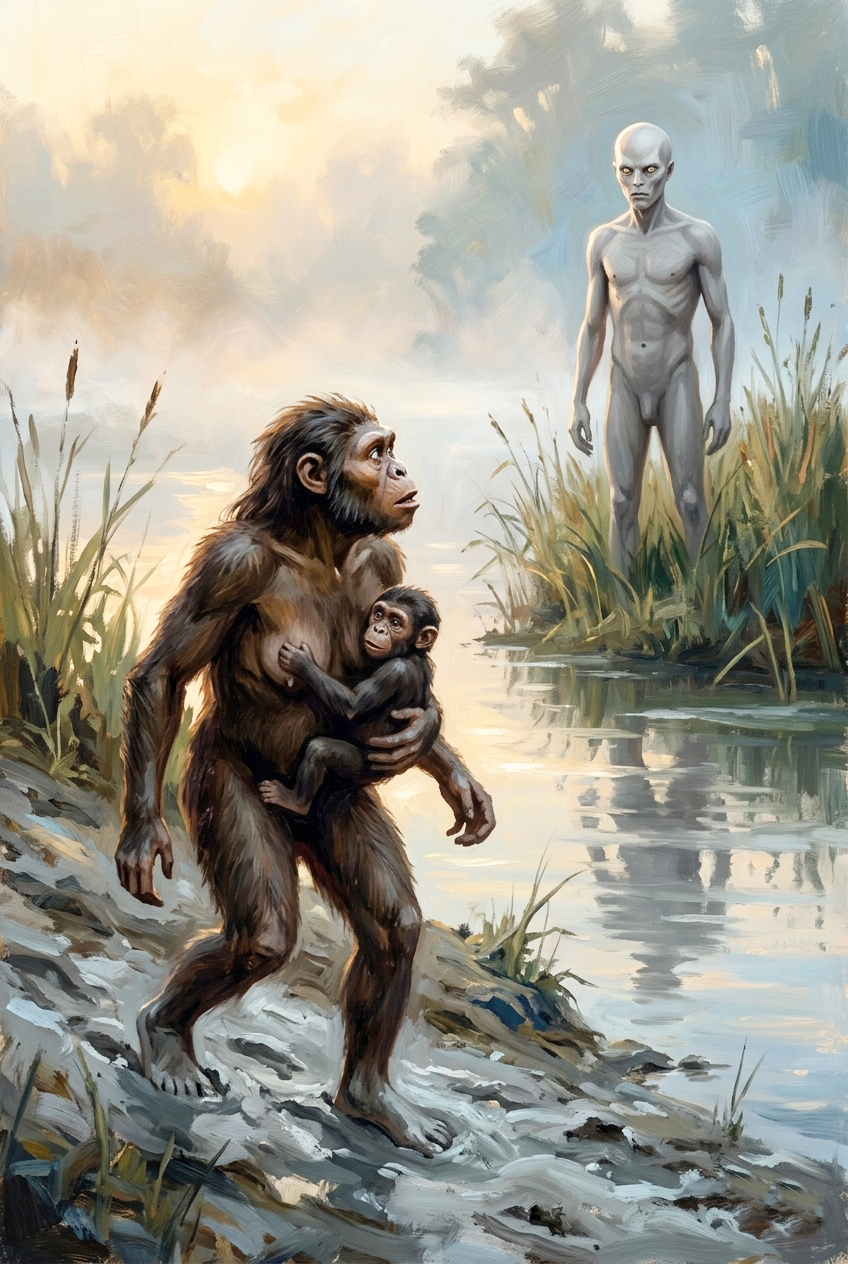
On a cold black African night, Asha huddles in the meagre shelter of a cave, her thin body trembling from more than just the cold air. She stirs fitfully, as the hunger pangs conspire to wake her. Hunger claws at her insides, gnawing relentlessly at her weakening resolve. Her baby, nestled against her chest, whimpers pitifully.
Earlier she’d laid down exhausted from her long walk in search of food, while the parched land remained stubbornly unyielding. The rains had still not arrived. She fears that her male partner, now missing for four days, is dead. With each passing day, her hope wanes.
The silence is ripped apart by the howl of a hyena. She sits up, shivering, her heart thumping, her senses on full alert. She has excellent hearing and eyesight – she needs it. The slightest hint of movement in the corner of her eye will trigger an adrenaline rush to help her survive a little longer.
She scans the river bank for any movement. Nothing, not a sound. Not even the faintest rustle to betray a lurking predator. Reluctantly, she lays back down, allowing her attention to drift skyward. There, the stars glitter like diamonds scattered across a vast black void. The patterns of stars are familiar to her. Some remind her of animals or birds she has encountered.
Last night she noticed a new star, a very bright star, pulsating and changing colour. She searches for it now, but it has not returned. She clutches the child to her breast and relaxes. Exhaustion finally claims her, and she drifts into a fitful sleep.
She dreams that her man has returned. He stands over her, smiling, offering her fruit and some meat scavenged from a dead wildebeest. But when she awakes with a start, the cruel reality of her situation comes crashing down upon her once more. He is not here. She is still alone.
Then she sees it. The new star has returned, even larger and brighter than before. It seems impossibly close, its low hum reverberating through the air. Asha’s voice trembles as she whispers to the heavens, her eyes locked on the strange flickering star. And though she cannot comprehend the force behind that pulsating light, she feels as though her life is about to change forever.
In the first light of dawn, her child clutched tightly to her breast, Asha moves cautiously down the slope, her bare feet sinking into the soft, cool mud. The water beckons her with its promise of relief from the parched feeling in her throat. As she drinks the cool water, she senses a presence and looks up. There, looking at her from the opposite bank is a strange creature. Standing upright like a man, but with no body hair, his smooth skin pale grey in colour. Its face is flat with a high forehead. The eyes are widely spaced and pale yellow like those of a wolf.
‘Who are you?’ she thinks, though she feels no fear.
The creature continues to watch her steadily. It points at her with a long, slender finger and beckons. She is overwhelmed with a feeling of warmth and contentment. Her hunger pangs disappear. The child stirs but no longer whimpers.
‘Come,’ the creature seems to say, its voice echoing in her mind, though its lips never move. She crosses the shallow river but has no recollection of reaching the other side.
Hours later she’s lying in the grass. The sun is now high in the sky. Something within her has shifted, and a newfound curiosity takes hold. She feels the urge to try something new.
She searches out two pieces of hard white rock and strikes one against the other. It produces a shower of bright sparks like tiny stars. Some of the sparks land in the parched grass and a curl of smoke drifts gently upwards. She tries it again. This time there is a tiny yellow flame beneath the smoke. Carefully, she breathes on it and the flame grows. She is astonished at this magic. Her man once carried a burning ember several miles from a distant bushfire, but it soon died and no one knew how to bring it back to life. Yet now, she holds the secret to creating fire herself.
For the rest of the day, she frantically practises her newfound skill. That night she proudly sleeps next to a warm fire which she keeps alive by feeding it with dry twigs. She realises that not only does it keep her and the child warm, but it keeps away the hyenas and bears which used to terrorise her.
‘Thank you…’ her eyes drifting to the sky as she sought the pulsating star and the mysterious being that has changed her life forever.
Asha wakes the next morning to the comforting warmth of the fire she has created. Her eyes flicker across the landscape, painted in hues of gold and orange from the rising sun. She glances at the sleeping child, still swaddled in animal skins, the fire’s heat a protective barrier against the chill of the night.
That morning she thinks of trying something else. Using the sharp edge of the hard white rock, she discovers she can fashion long straight shafts from willow branches. Then by repeatedly striking one rock against another, she can, with practice, fashion a triangular-shaped stone with a sharp edge to each side. She fastens this shape to the end of the willow shaft using several turns of creeper soaked in tree resin and hardened by the fire. Her fingers move with purpose, guided by an inner knowledge she doesn’t understand but trusts implicitly. It is as though she always knew how. The pale creature has given her a gift, and she feels a burning need to explore it further.
That afternoon, Asha ventures into the wilderness, spear in hand, her senses heightened by the pale creature’s influence. She crouches in silence near a bush, the world around her coming alive as she waits for her prey. Finally, a rabbit appears. As the rabbit sits sniffing at the air she flings the spear with all her might. The rabbit turns towards the sound, but it is too late. She is amazed to discover that by roasting the rabbit meat against the fire, it is tastier and easier to chew than raw meat.
As the scent of roasting meat fills the air, Asha marvels at the change that has come over her since her encounter with the pale creature. Knowledge flows through her veins, igniting a fire within her soul that refuses to be extinguished.
Over the following years, as her male child thrives and grows, she continues to teach him the new-found skills and knowledge that the pale creature had bestowed upon her. Together, they practise their hunting techniques, gathering food for their small group. As the seasons pass, Asha’s son grows taller, his shoulders broadening as he takes on more responsibility.
One day, his voice firm with resolve, he declares that he must leave. Asha nods, her heart swelling with pride and sadness. She knows it is time for him to seek out a mate and pass on his genes. She embracing him tightly as he turns and disappears into the wilderness, leaving Asha alone once more.
Days later, while attempting to spear a fish, Asha finds herself struggling against the slippery mud beneath her feet. The rains have come, and the swollen river roars in her ears as she leans precariously over the water, her spear poised to strike. Just as she is about to make her move, her foot slips on the muddy bank, sending her tumbling into the raging waters below. She cries out, panic seizing her chest as the current pulls her under. Desperately, she reaches for an overhanging branch, her fingers brushing against its bark. But her foot becomes trapped in a tangle of tree roots, leaving her helpless to fight against the relentless current. Too weak to swim against the flow, she succumbs, losing her final battle to survive.
Her frail body slowly disappears beneath the mud and silt of the river bed. Over hundreds of thousands of years, the silt and mud build up, getting thicker and thicker, until the sheer weight compresses it into sedimentary rock, forever preserving her legacy.
New rivers form. The landscape and climate change many times. Volcanoes come and go. In the vast expanse of the cosmos, a new star shimmers brightly, its pale yellow light shining down on the world where Asha’s story began. The star’s light continues to shine down on the world for millennia, watching as the land shifts and changes. The animals that once roamed the earth evolve and adapt, becoming new species altogether. The humans that Asha had once known become ancient history, their stories only preserved in the rocks and sediment that encased them.
In November 1974, during a hot afternoon, nearly three and a quarter million years later, a pair of young anthropologists are in Hadar, part of the Great Rift Valley in Ethiopia. Their names are Donald Johanson and Tom Gray. They have been surveying the area for fossils and are strolling back to the Land Rover when Donald Johanson notices a bone fragment protruding from the side of a gully, recently exposed by erosion of the parched soil. He recognises it as part of the arm bone of an early hominid, a human ancestor.
Later, they find a skull bone, a femur, some ribs, a pelvis, and a lower jaw bone. Two weeks later, after many hours of excavation, screening, and sorting, several hundred fragments of bone have been recovered, representing forty per cent of a single hominid skeleton. Johanson can tell from the size and shape of the pelvis that it was a female. She was short with long arms and a small brain like a chimpanzee, but the shape of her knee and pelvis showed that she could walk upright, not like a chimp, but like a human. Nearby, they find several flint arrowheads.
The deposits in which these fossils were found contained remnants of volcanic flows and ashes, which can be dated. Armed with these dates and bolstered by palaeomagnetic and sedimentological studies, researchers can date the fossils with surprising precision. By using a combination of these techniques, the hominid’s age has been estimated to be just under 3.2 million years old.
They named the hominid Australopithecus Afarensis, which means Southern Ape. Privately, however, Johanson named her ‘Lucy’ after his favourite Beatles track ‘Lucy in the Sky with Diamonds.’
J M Tonks
